
5 Best Vertical Drama App Developers for Launching Short-Form Drama Platforms
Published on November 13, 2026 at 12:25 PM
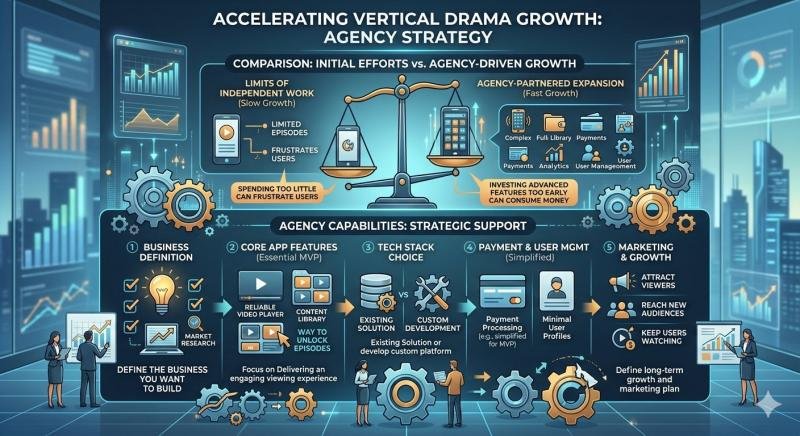
Vertical drama has become one of the most interesting formats in mobile entertainment. Instead of long episodes designed for traditional television or streaming platforms, vertical drama delivers short, serialized stories through a mobile-first viewing experience.
The format is usually built around vertical 9:16 video, short episodes, rapid storytelling, and cliffhangers that encourage viewers to continue watching. Monetization can include subscriptions, advertising, virtual coins, and paid episode unlocking.
The growing number of vertical drama platforms shows that the model is no longer limited to a few experimental applications. Current industry directories list platforms such as ReelShort, DramaBox, NetShort, DramaWave, GoodShort, ShortMax, and others across different markets.
This creates an opportunity for startups, production companies, media businesses, and entrepreneurs to build their own short-form drama platforms.
However, developing a vertical drama app involves considerably more than creating a video player.
A complete platform may require mobile applications, video streaming infrastructure, content management, user accounts, personalized feeds, episode management, payments, subscriptions, coin wallets, notifications, analytics, administration tools, and scalable backend architecture.
There is also an important business decision to make before development begins.
A company can build a platform completely from scratch, use a white-label solution, purchase and customize existing source code, or start with a ready-made application. The right option depends on the startup's budget, technical resources, content strategy, launch timeline, and long-term goals.
Below are five companies and platforms worth evaluating for businesses planning to launch a vertical drama application.
1. Triple Minds
Triple Minds is a technology company offering consulting, development, and marketing services, with a dedicated vertical drama app development offering for startups and media businesses.
What makes Triple Minds particularly relevant to this category is that it does not limit businesses to a single development route. Its current vertical drama offering includes white-label vertical drama apps, ReelShort and DramaBox-style clone development, custom vertical-series platform development, and MVP development.
This gives startups more flexibility when deciding how aggressively they want to enter the market.
For example, a business that wants to test its content concept quickly may choose an MVP. A company with a larger content catalogue and a defined brand may prefer a white-label platform. A media company with a unique business model may require a completely custom application.
Triple Minds' white-label solution is positioned as a ready-made platform that can be rebranded and launched under a company's own identity. Its listed capabilities include Android and iOS user applications, coin-based episode unlocking, subscriptions, an admin panel, and CMS functionality.
The clone-development approach is designed around the core mechanics that have become common in the vertical drama category. These include swipe-based content discovery, episodic releases, cliffhanger-driven paywalls, coin wallets, and customized branding and monetization rules.
Custom development provides a different route.
A startup may want to build a regional-language platform, a multi-creator marketplace, a hybrid OTT and short-drama service, or an investor-backed entertainment product that needs a different architecture. Triple Minds positions its custom route for these types of requirements.
The company also offers an MVP approach for businesses that want to validate their audience, content, and unit economics before committing to a larger rollout.
This range of options makes Triple Minds a strong fit for businesses that are still deciding exactly how their vertical drama product should be launched.
Best For: Startups and media businesses looking for custom, white-label, clone-based, or MVP vertical drama app development.
2. Burj Code
Burj Code is a Dubai-based technology and digital growth company that develops mobile and web applications along with supporting backend and digital infrastructure.
For vertical drama businesses, a development partner like Burj Code can be relevant when the project requires a customized technology stack rather than simply a ready-made application.
A vertical drama platform can involve several connected systems.
The viewer-facing application needs to provide smooth vertical playback and content discovery. Behind it, the business needs backend services, APIs, content-management functionality, payment systems, analytics, authentication, notifications, and administrative controls.
As the platform grows, infrastructure becomes increasingly important.
A successful drama series can generate large numbers of simultaneous viewing sessions. Video delivery therefore needs to be designed with scalability and performance in mind rather than treating the application as a conventional content catalogue.
Burj Code's broader mobile and software development capabilities can be useful for startups that want these different components developed as part of one technology project.
Another consideration is product differentiation.
A new vertical drama platform does not necessarily need to copy the exact structure of an existing application. A startup may instead focus on a particular country, language, genre, creator community, or audience segment.
For example, a business targeting regional audiences could build a platform around local-language dramas and localized payment methods. A production company could create an application focused entirely on its own original series. A media startup could combine short drama with other forms of entertainment.
These use cases can require customized product architecture and user experiences.
Burj Code can therefore be considered by businesses that want a technology development partner capable of supporting the application and the broader digital infrastructure around it.
The exact vertical-drama features, streaming architecture, and third-party integrations should be established during project discovery rather than assumed from a general development portfolio.
Best For: Businesses that want customized mobile, web, backend, and technology development for a vertical drama platform.
3. Sell My Code
Sell My Code follows a different model from a traditional custom app development company.
It operates as a software and source-code marketplace, making it relevant to startups that want to begin with an existing application foundation instead of commissioning every component from scratch.
The platform currently lists vertical drama-related source-code products, giving businesses an option to evaluate ready-made software for this market. Its model can be attractive to technical founders who already have developers capable of reviewing and customizing an existing codebase.
The biggest potential advantage is control.
With a suitable source-code product, a startup can potentially modify the user interface, integrate its preferred services, adjust the business logic, and build new features around the existing foundation.
This can be useful when speed is important but the startup still wants more technical control than a completely hosted solution provides.
However, buying source code is not the same as buying a finished business.
A startup should examine the technology stack, code quality, documentation, security, third-party dependencies, licensing terms, scalability, and maintenance requirements before committing to a particular product.
The company should also determine exactly what is included.
For a vertical drama application, this could mean checking whether the source code includes Android and iOS applications, backend services, admin functionality, CMS tools, payment integration, video management, and other required components.
Licensing is equally important.
If the startup intends to operate the application commercially or rebrand it as its own product, it should verify that the purchased licence permits the intended use.
This makes Sell My Code particularly suitable for technically capable startups rather than founders who want a completely managed development service.
The marketplace approach can reduce the amount of work required to create an initial product, but the startup still needs technical expertise to turn the source code into a production-ready platform.
Best For: Technical startups and founders looking for existing vertical drama source code that can be reviewed, customized, and developed further.
4. Make An App Like
Make An App Like focuses on ready-made and clone-based application solutions, making it relevant to startups that want to use an established product model as the foundation for their vertical drama application.
Its vertical drama and short-drama development material discusses architectures and features associated with applications such as DramaBox, including vertical 9:16 playback, HLS streaming, CDN delivery, coin-based episode unlocking, recommendation systems, and scalable backend infrastructure.
This type of development approach can be useful for startups that already understand the product they want to launch.
Instead of spending months defining every element of the platform architecture, a business can begin with a familiar application model and customize it according to its own brand and audience.
However, cloning the basic mechanics of a successful application should not mean copying the entire business.
The strongest opportunity for a new vertical drama platform may come from differentiation.
A startup could focus on a specific language, regional audience, genre, content creator network, or monetization model. The technology provides the infrastructure, while the company's content strategy creates the reason for viewers to choose the new platform.
For example, a business could build a vertical drama application specifically for regional-language stories. Another could focus on romance and relationship dramas. A production studio could create a platform dedicated to its own original catalogue.
The underlying application may follow familiar vertical drama mechanics while the actual business experience remains distinct.
Make An App Like can therefore be useful for entrepreneurs who want a ready-made or clone-based starting point while retaining room for customization.
As with any ready-made software solution, startups should verify the exact product being offered, included features, source-code access, licensing, customization scope, deployment responsibilities, and post-launch support before making a final decision.
Best For: Startups looking for a ready-made or clone-based foundation for a customized vertical drama application.
5. Prebuild Apps
Prebuild Apps represents the prebuilt application route for businesses that want to reduce the amount of development required before launching a digital product.
This approach can be attractive to early-stage companies because it allows them to focus more of their initial resources on content, branding, marketing, and audience acquisition instead of building every technology component from scratch.
For vertical drama, this can be particularly important.
The application is only one part of the business. A startup also needs a reliable content pipeline, actors and production resources, story development, episode scheduling, marketing, user acquisition, and retention strategies.
A prebuilt technology solution can potentially shorten the initial product-development process and allow the business to concentrate on these other areas.
However, startups should not select a prebuilt platform based solely on how quickly it can be launched.
The solution needs to support the actual operating model of the business.
For example, the platform may need vertical 9:16 video playback, series and episode management, content uploads, premium episode controls, subscriptions, coin-based payments, notifications, analytics, user accounts, and administrative tools.
The business should also determine how much customization is possible.
A prebuilt platform may work well for a startup that wants to validate an idea with a relatively standard product. It may be less suitable for a business that has a highly specialized content model or wants to build a differentiated entertainment ecosystem.
Ownership and licensing should also be reviewed carefully.
Before signing up, the startup should establish whether it receives source-code access, whether hosting is included, how deployment works, who handles updates, what technical support is available, and what happens if the business eventually wants to migrate to a custom platform.
Best For: Early-stage businesses that want a prebuilt technology foundation and a faster path toward testing a vertical drama business.
What to Look for in a Vertical Drama App Developer
Choosing a development partner should begin with the business model rather than the application design.
Vertical Video and Streaming
Vertical drama depends heavily on the viewing experience.
The application should be designed around portrait video and short viewing sessions. Streaming architecture, video compression, CDN delivery, and adaptive playback can all affect whether users continue watching.
Episode Management
The platform should make it easy to organize dramas into series and episodes.
A strong CMS should allow administrators to upload content, schedule releases, manage descriptions and thumbnails, determine which episodes are free or premium, and update the catalogue without depending on developers for routine changes.

Written by James Edward
Please login to comment on this post.